

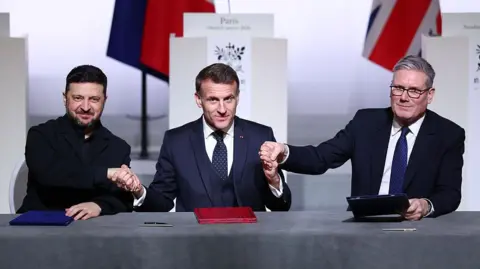
The London and Paris have signed a declaration of intent concerning the positioning of armed personnel in the nation in the event a peace deal be struck with Russia, the UK Prime Minister, Keir Starmer, has declared.
Subsequent to talks with Kyiv's partners in the French capital, he noted that the UK and France would "set up defense centers throughout Ukraine and construct protected facilities for military hardware and military equipment" to deter any future invasion.
The partner countries also put forward that the United States would assume leadership in verifying a ceasefire.
Moscow has repeatedly warned that any external forces in Ukraine would be considered a "acceptable aim", but has as yet not issued a statement on this latest declaration.
The Situation and Ongoing War
Russian President Vladimir Putin began a full-scale invasion of Ukraine in the start of last year, and Russia presently controls about 20% of Ukraine's sovereign soil.
"This is a vital part of our pledge to support Ukraine for the duration," stated the British leader.
National leaders and senior officials from the "Partner Group" participated in the Paris negotiations.
Speaking at a shared media briefing, he further said: "It paves the way for the juridical structure under which British, French, and partner forces could function on the ground in Ukraine, defending Ukraine's skies and seas, and regenerating Ukraine's military for the years ahead."
The UK prime minister added that London would be involved in any US-led monitoring of a potential ceasefire.
Protection Pledges and Negotiation Stances
Top US negotiator Steve Witkoff stated that "long-term defense assurances and substantial reconstruction vows are essential to a enduring ceasefire" in Ukraine – referring to a key demand made by Kyiv.
He said the partner nations had "mostly completed" their work on agreeing such assurances "in order that the citizens of Ukraine know that when this conflict ends, it ends forever."
Donald Trump's son-in-law, US President Donald Trump's representative, also participated in the discussions.
At the same time, France's leader Emmanuel Macron stated that Ukraine's partners had made "considerable progress" at the negotiations.
He added that "robust" safety pledges for the Ukrainian government had been agreed in the case of a prospective truce.
Ukrainian President Volodymyr Zelensky stated that a "major development" had been made in the talks, but cautioned that he would only deem efforts to be "sufficient" if they resulted in the end of the war.
Last week, the Ukrainian leader said a peace deal was "largely prepared". Settling the outstanding 10% would "shape the outcome of the agreement, the fate of Ukraine and Europe".
Remaining Challenges
- Land and security guarantees have been at the forefront of ongoing disputes for the parties involved.
- Putin has often said that Ukraine's forces must withdraw from all of Ukraine's eastern Donbas or Russia will seize it, dismissing any concession over how to conclude the war.
- Kyiv has to date rejected ceding any land, but has floated the idea that Ukraine could pull back its troops to an agreed point – but only if Russia does the same.
Moscow currently controls approximately 75% of the Donetsk oblast and around 99% of the adjacent Luhansk. The two regions form the industrial region of the Donbas.
The original US-led comprehensive proposal that was widely leaked to the media last year was viewed by Ukraine and its EU supporters as being heavily skewed in Moscow's favor.
This sparked weeks of intensive discussions – with all sides trying to revise the proposal.
The previous month, The Ukrainian government presented the US an new framework – as well as additional documents detailing possible security guarantees and plans for Ukraine's rebuilding, Zelensky added.


